
If you are evaluating Redmine for your team, one question tends to come first: does anyone still use Redmine? It is a fair question for a tool that launched back in 2006. The market is now full of newer platforms with slick interfaces and heavy marketing. Yet Redmine has not disappeared. It is still developed, maintained, and used by organizations worldwide, and its latest release arrived in August 2026.
Does anyone still use Redmine?
Yes. Redmine is still used by thousands of organizations in 2026 and remains actively maintained. Its latest stable release, Redmine 7.0.1, arrived in August 2026. Because Redmine is open-source and self-hosted, there is no official user count, but independent technology trackers consistently identify thousands of companies running it worldwide.
The strongest evidence is Redmine’s own development activity. The project released Redmine 7.0 on June 30, 2026, followed by maintenance and security releases across the 7.0, 6.1, and 6.0 branches. Redmine is not sitting untouched on a server somewhere. The project is still moving forward.
How widely is Redmine used?
There is no reliable public figure for the total number of Redmine installations worldwide. That gap is expected with self-hosted software, not a sign of decline.
Technology platforms such as Enlyft and TheirStack identify thousands of organizations associated with Redmine, but their numbers do not match. For example, Enlyft currently lists more than 16,000 companies associated with Redmine, while TheirStack produces different figures depending on the geography and dataset.
These numbers help you understand the size of Redmine’s detectable user base. They should not be treated as an official customer count, since many private installations never appear in these databases. The safest conclusion is straightforward. Redmine has a substantial global installed base, but nobody can count every installation worldwide.
Which teams use Redmine?
Redmine makes the most sense for teams that want more control over their project management environment. Its users cluster in engineering-heavy industries with structured, long-running work.
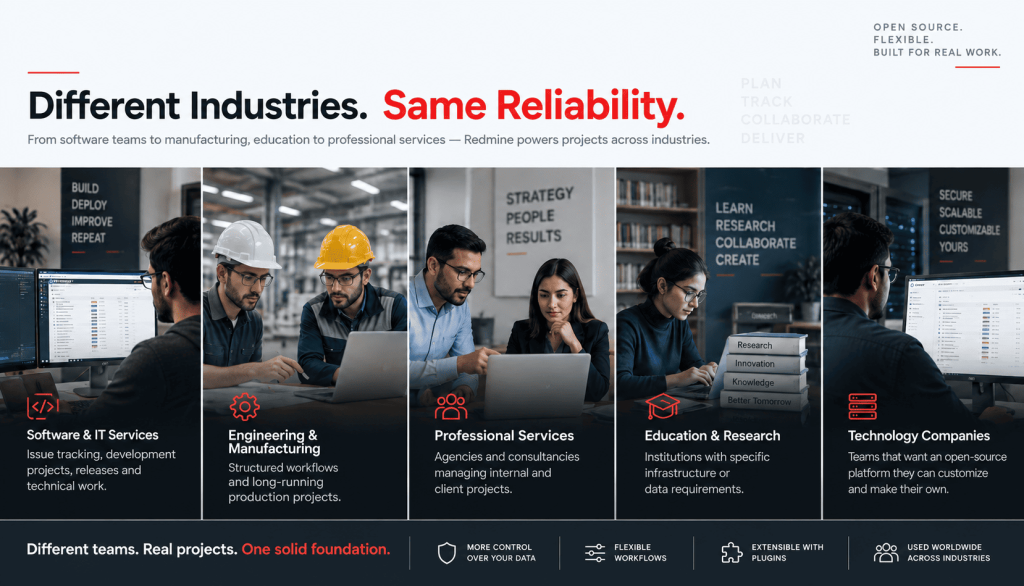
Common use cases include:
- Software and IT services — issue tracking, development projects, releases, and technical work.
- Engineering and manufacturing — structured workflows and long-running projects.
- Professional services — agencies and consultancies managing internal and client projects.
- Education and research — organizations with specific infrastructure or data requirements.
- Technology companies — teams that want an open-source platform they can customize.
Technology datasets also identify Redmine usage across countries including the United States, France, Germany, Spain, and India. For a broader look at the platform, see our guide to what Redmine is used for.
What is the latest version of Redmine?
As of September 2026, the latest stable release is Redmine 7.0.1, released on August 26, 2026. The project also shipped Redmine 6.1.4 and Redmine 6.0.11 on the same date.
These releases included multiple security fixes, bug fixes, and maintenance improvements. Redmine 7.0.1 also updated its framework to Rails 8.1.3.1 and patched four security vulnerabilities. That activity matters when you evaluate an older platform. Redmine may have started in 2006, but its current codebase is still actively maintained.
What changed in Redmine 7.0?
Redmine 7.0 is a good example of how the platform keeps evolving. Released on June 30, 2026, Redmine 7.0 delivered 122 changes: 63 features, 43 patches, and 16 defect fixes.
Webhooks. Redmine 7.0 introduced webhook triggers, which make it easier to connect Redmine events with other applications and automation.
Rails 8. The release moved Redmine to Rails 8, updating a major part of the technology underneath the application.
Header and navigation redesign. Redmine 7.0 reworked the header with a navigation bar and lighter visual weight. This matters, because the interface draws much of Redmine’s criticism.
Better RTL support. The release also improved right-to-left language layouts for teams working in those languages.
So while Redmine is two decades old, it is not running on the same software it shipped years ago.
Is Redmine outdated?
This is where the answer needs nuance. Redmine’s default interface can look dated, but that does not mean the platform itself is outdated.
Placed next to a modern SaaS product, the difference is noticeable. Newer tools often have more polished dashboards and simpler onboarding. Look past the interface, though, and Redmine still provides a deep feature set: custom workflows, roles and permissions, custom fields, issue tracking, roadmaps, time tracking, Gantt charts, repository integration, a REST API, plugins, themes, and self-hosting.
So there are really two separate questions. Does Redmine’s default interface look old? For some users, yes. Is Redmine abandoned or technically frozen? No. That distinction matters when you decide whether to replace Redmine or simply improve the experience around it.
Why do companies still choose Redmine?
Teams generally choose Redmine for practical reasons, not habit.
Data control. Redmine runs on your own infrastructure, giving your organization control over where project data is stored. For teams with security or compliance requirements, that control is often essential.
No per-user SaaS license. Redmine is open-source under the GNU GPL v2, so there is no per-seat subscription for the core software. Running it is not free, though, since hosting, administration, and maintenance carry costs.
Flexible workflows. Redmine lets teams configure trackers, statuses, workflows, permissions, and custom fields around existing processes. That flexibility helps when your workflow does not fit a standard SaaS template.
Plugins. A large plugin ecosystem extends the platform with agile boards, dashboards, advanced reporting, helpdesk features, resource planning, and integrations. That extensibility keeps Redmine viable for very different teams.
Can you make Redmine look more modern?
Yes, and this matters for existing users. You do not have to migrate away from Redmine just because the default interface disappoints your team.
Themes and plugins can change the experience considerably. You can add modern dashboards, improved navigation, agile boards, reporting, and helpdesk workflows while keeping your existing projects and workflows intact. That is the idea behind the Redmineflux plugin suite. Instead of replacing an established environment, Redmineflux helps teams extend it for a more modern Redmine experience. In short, Redmine, upgraded for modern teams.
Modernize Your Redmine
Upgrade your Redmine experience with Redmineflux. Explore Plugins →
Redmine vs. modern SaaS platforms
This comparison is not really about which product is better. It is about what your team needs.
Modern SaaS platforms generally offer quick setup, managed infrastructure, automatic updates, and a polished interface. Redmine offers self-hosting, control over infrastructure, open-source licensing, flexible workflows, and deep customization.
If your team does not want to manage servers or updates, a SaaS platform may fit better. If you need control over your data and have technical resources to customize, Redmine remains a practical option. For a detailed breakdown, see our Redmine vs Jira comparison.
Is Redmine free?
Yes. Redmine is free and open-source software released under the GNU GPL v2. There is an important difference, though, between free software and free operation.
If you self-host Redmine, you may still pay for hosting, server administration, backups, monitoring, security, upgrades, plugins, and support. Teams that would rather not manage that infrastructure can use managed Redmine hosting instead. Our Redmine cost and pricing guide breaks down the full picture.
Is Redmine still relevant in 2026?
Yes. Redmine is twenty years old, but age is not the same as obsolescence. The project released Redmine 7.0 in June 2026 and 7.0.1 in August. The latest release fixed four security vulnerabilities and added further improvements.
Redmine also stays focused on the strengths that have always made it attractive: control, flexibility, self-hosting, open-source licensing, and extensibility. It is not the right fit for every team. But if those characteristics matter to your organization, Redmine remains worth serious consideration. And if your main complaint is that Redmine feels dated, you may not need to replace the platform at all. You can modernize the experience while keeping the reliable core underneath.
Want to modernize your Redmine setup?
If your team already uses Redmine but wants a more modern experience, plugins, themes, and managed services can extend what the platform already does.
Explore Managed Cloud · Book a Free Demo
Frequently asked questions
Does anyone still use Redmine?
Yes. Independent technology databases continue to identify thousands of organizations associated with Redmine in 2026. Because Redmine is self-hosted, there is no official global customer count, and actual usage is likely higher than trackers can measure. It stays popular in software, IT services, manufacturing, and education.
Is Redmine still being updated in 2026?
Yes. Redmine 7.0 was released in June 2026, followed by Redmine 7.0.1 on August 26, 2026. The 6.1 and 6.0 branches also received maintenance and security releases. Regular updates across multiple branches show the project is actively developed, not abandoned.
What is the latest version of Redmine?
As of September 2026, the latest stable version is Redmine 7.0.1, released on August 26, 2026. The project also maintains the 6.1.x and 6.0.x branches with security and bug fixes, so several supported versions are available depending on your upgrade needs.
Is Redmine outdated?
No, though its default interface can feel dated next to newer SaaS platforms. The underlying software is stable and still receives development, security updates, and new features such as webhooks and a redesigned header in version 7.0. Modern themes and plugins resolve the appearance without replacing the core.
Is Redmine free?
Yes. Redmine is open-source software released under the GNU GPL v2, so it is free to download and run. However, self-hosting still involves costs for hosting, maintenance, administration, and any optional plugins or managed services you add.
Can Redmine be modernized?
Yes. Themes, plugins, integrations, and managed services can improve Redmine’s functionality and interface without replacing the core platform. This lets teams keep existing projects and workflows while adding modern dashboards, agile boards, and reporting on top.
Get More From Redmine
Powerful plugins. Better workflows. Explore Redmineflux →